
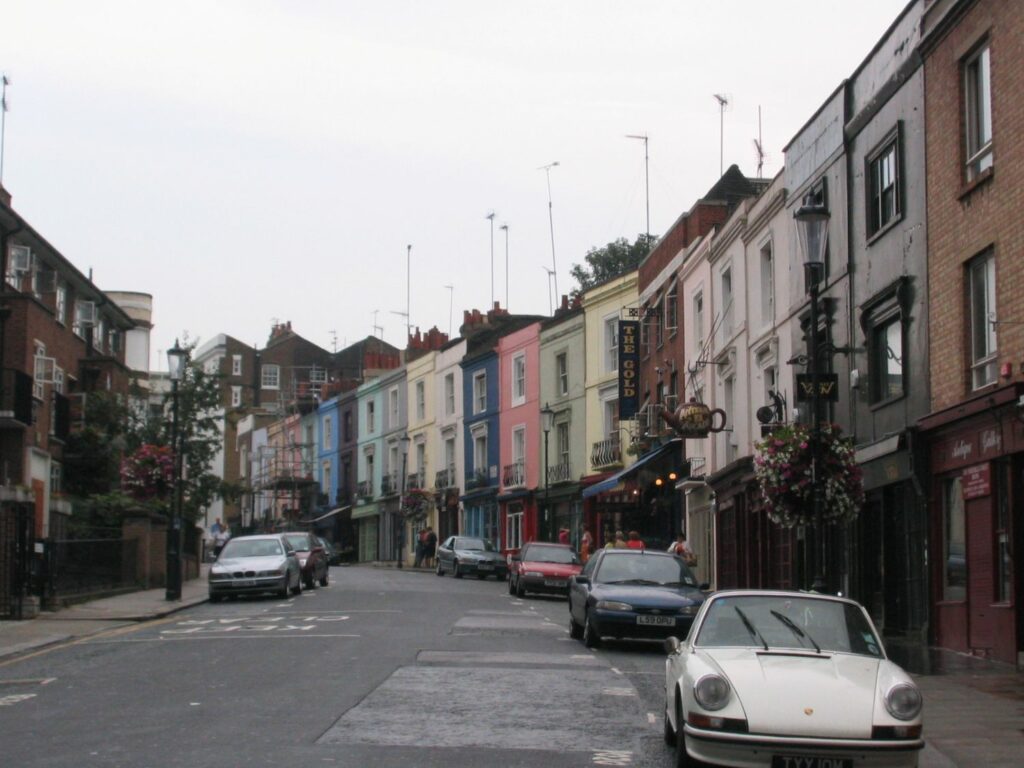
Stand at the Chepstow Villas end of Portobello Road early on a Saturday and you can still watch the old routine, trestles going up while the silver comes out of felt-lined boxes. By ten the crowds from Notting Hill Gate have arrived, and half of them are looking for the blue door from the film.
This is the stretch Kensington and Chelsea has chosen to fix first.
On 10 February the council approved a £4.4m plan for Portobello Road, covering wider pavements, new lighting, more greenery and a proper answer to the flooding. Nobody sensible objects to drains. Mind you, a street can be resurfaced, replanted and relit to a very high standard and still lose the thing people crossed the world to see, and on Portobello that loss is already well under way.
What is £4.4m buying on Portobello Road?
Quite a lot, on paper. According to Time Out’s report of the approval, the scheme brings wider pavements, new lights, accessibility upgrades, extra planting and parking bays. The concrete anti-terror blocks that went in a few years ago on Metropolitan Police advice are to be swapped for sliding bollards.
None of it touches the council tax. The money comes from the Community Infrastructure Levy, the charge Kensington and Chelsea collects from developers, and the plan followed a six-week public consultation in 2025.
Work is due to start in January 2027. Phase one covers Chepstow Villas to Westbourne Grove, which happens to be the antiques heart of the street. Phase two runs from Westbourne Grove up to Elgin Crescent.
The street was a country path long before it was a postcard. Until around 1740 it was Green’s Lane, winding from the Kensington Gravel Pits at what is now Notting Hill Gate up towards Kensal Green, and it took its present name from Portobello Farm, itself named after Admiral Vernon’s capture of Porto Bello in 1739. Nearly three centuries later the council is still, in effect, deciding what the lane is for.
Why does the drainage matter so much?
Because Portobello has already had its warning. In July 2021 a storm dumped what the Antiques Trade Gazette described as “a month of rain in 90 minutes” on Notting Hill, flooding homes and shops and leaving arcade dealers bailing out basements full of stock. Some residents had to move out temporarily.
The new system, called Hydrorock, uses underground tree pits and absorbent blocks to hold rainwater and slow its run into the sewers. For a dealer with Georgian furniture in a basement below street level, that is the best thing in the whole £4.4m. It is also the least photogenic.
Who is actually left in the arcades?
Fewer dealers every year, and the numbers matter more here than the pavements.
Portobello’s antiques trade runs on two quite separate systems, and most visitors can’t tell them apart. Out on the street are the pitches licensed by the council itself – 43 of them, according to a dealer who wrote to the Antiques Trade Gazette in 2024, and those stalls are protected by law because the council runs them. Behind the shopfronts are the arcades: warrens of small units, cabinets and glass counters, where serious dealers in silver and scientific instruments have traded for decades. The arcades are privately owned. Nothing protects them except the landlord’s patience.
The biggest landlord in the story is Portobello Group, which owns many of the arcades. When lockdown shut the market in 2020, the Gazette reported that the company offered traders full rent relief for the closed period on conditions, and that some dealers were unlikely to return regardless.
That patience has been running short. In September 2024 the dealers in the Dolphin Arcade were served with eviction notices, and the Gazette headlined the story as the street losing yet another of its historic arcades. A month later the paper profiled a specialist in scientific instruments, billed as the last of Portobello’s “scientists”, who had been pushed out of his arcade unit and was reduced to hoping for a return while he traded at fairs instead.
The old guard is thinning in the ordinary way too. John Odgers, a long-standing Portobello dealer, died in July 2024 at 82, and the trade press ran his obituary alongside the eviction news that same autumn.
Then, on 20 March this year, came the next blow. The Gazette reported plans for a comprehensive refurbishment of another of the street’s antiques arcades, with further disruption for the dealers working inside it. A refurbishment can mean new wiring and a lick of paint. On a street where Dolphin Arcade has already gone, dealers will read it as the first line of a longer letter.
What does a traffic barrier do to a furniture dealer?
Ask anyone who has tried to get a mahogany chest of drawers out of a van.
In August 2025 the Gazette reported that the council’s new terror-prevention barriers were causing real problems for dealers in the shops and stalls. Antiques are heavy and frequently fragile, and a trade that depends on loading and unloading at dawn does badly on a street designed to keep vehicles out. The street had already gone permanently car-free in November 2021, so the barriers landed on a trade that had spent four years adjusting to one set of restrictions before another arrived. The barriers protect crowds. They also make it harder to be a dealer on Portobello Road, and every dealer who gives up makes the crowds a little less worth protecting.
Has the council spent £4.4m fixing its own mistake?
Partly, yes.
The concrete blocks were the council’s answer to a genuine risk. Portobello on a Saturday is a dense pedestrian crowd in a narrow street, and nobody wants to explain afterwards why it went unprotected. The blocks were also ugly and bad for business, and within a few years Kensington and Chelsea is paying to replace them with sliding bollards that can open for deliveries.
Is a sliding bollard a victory?
A small one. It hands back access the dealers should never have lost, and by any honest accounting that counts as a repair. Filing it under investment in the antiques trade would take some nerve.
Should Kensington and Chelsea buy an arcade?
Here is the position that will irritate the council, the arcade owners and a good few residents at once: the Royal Borough should stop treating Portobello’s antiques trade as a backdrop and buy one of the arcades outright.
The council already runs the street market and already protects its 43 pitches in law. It already accepts, through its own stall licensing, that the trade is worth defending from the open market. The arcades are where that argument falls apart, because the moment a dealer steps indoors, the protection ends and the rent review begins.
A council-owned arcade let at sustainable rents to working dealers, with a rule that units go to people who sell antiques rather than phone cases and fridge magnets, would do more for the character of the street than any amount of new planting. It is roughly what the Cecil family’s estate is reported to do for the booksellers of Cecil Court off Charing Cross Road, and the street is still full of books.
The obvious objection is cost. A freehold on Portobello Road isn’t cheap, and the Community Infrastructure Levy can’t be spent on buying shops. So find the money elsewhere. Kensington and Chelsea is not a borough short of assets.
The less obvious objection is that it would be picking winners. Correct. That is the point.
And spare me the line that the film tourists are ruining Portobello. They are the reason the arcades still get footfall at all. A visitor who came for Hugh Grant’s bookshop and leaves with a Victorian silver teaspoon is exactly the customer the trade needs, and dealers who sneer at them are sawing off the branch they sit on.
What will January 2027 look like on Westbourne Grove?
Scaffolding, most likely, with dealers working around contractors on the busiest antiques stretch in London for months on end.
When the hoardings come down, Portobello Road between Chepstow Villas and Westbourne Grove will have wider pavements, better lights, trees in engineered pits and bollards that slide. The pastel houses will photograph beautifully. Paddington fans will still come.
Who will still be trading when the hoardings come down?
North of Elgin Crescent, beyond the scheme’s reach, the market carries on under the Westway and up to Golborne Road, scruffier and cheaper, and nowhere in the new drawings. Some of the dealers squeezed out further south may end up there. Mind you, that stretch has its own landlords.
For the antiques stretch, everything depends on decisions being taken right now in arcade leases the public never sees. The council’s drawings show where the new lampposts go. They don’t show a single dealer.
