
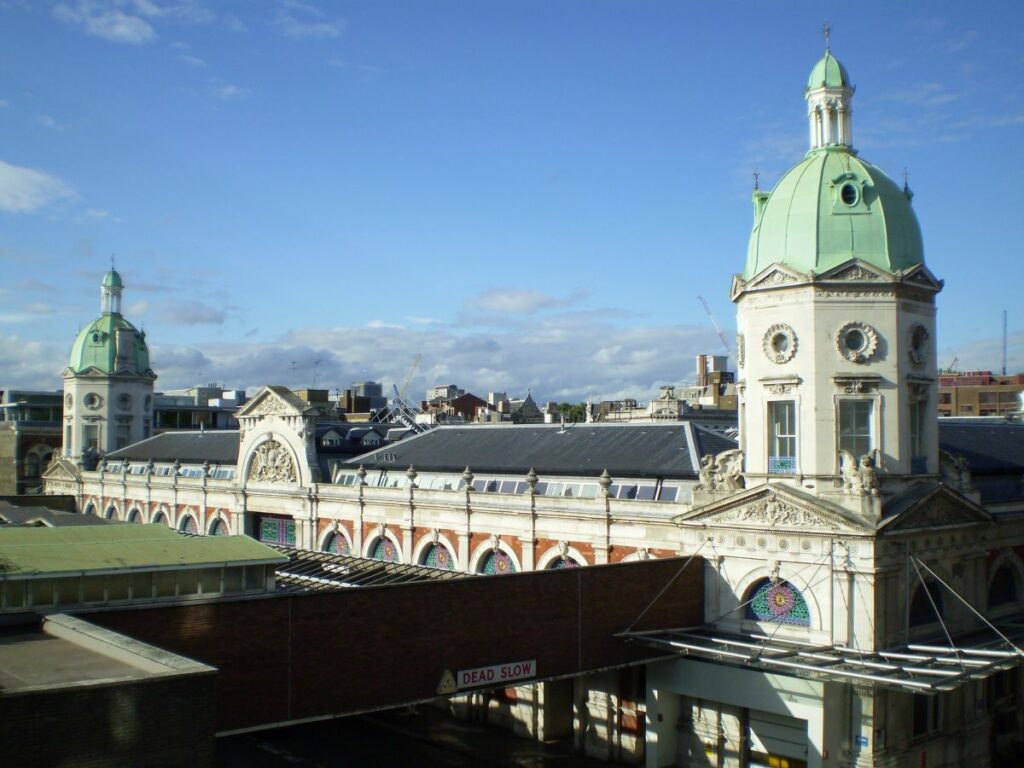
At four in the morning on a weekday, the lorries are still backing into the loading bays along Charterhouse Street, and men in white coats are wheeling carcasses under the painted ironwork of the East Market. Across West Poultry Avenue, the old General Market is lit up too. That one has builders in it.
On 28 November the General Market opens as the new London Museum. For a couple of years, the meat traders of Smithfield will work next door to an institution whose job is to tell the story of places like theirs after they’ve gone.
Nobody planned it as a joke. It works as one anyway.
Smithfield has been trading in some form since at least the 1170s, when it was first written down as the “smooth field” outside the city walls. The current traders are expected to leave by 2028 or 2029 for a new site at Albert Island in the Royal Docks. Mind you, most of them want to go – which is the part the nostalgic coverage keeps leaving out.
What opens next door on 28 November?
A very expensive museum in a very beautiful building. The General Market was designed by Sir Horace Jones, the architect of Tower Bridge and Leadenhall Market, and opened in 1883. It traded for over a century, shut in the 1990s and spent thirty years decaying while the City argued over what to do with it.
The £437m restoration, a partnership between the City of London Corporation and the Mayor of London, has been designed by Stanton Williams and Asif Khan with the conservation architects Julian Harrap. The permanent galleries go underground, and the space beneath the great dome is given over to events. There’s a six-metre window onto the Thameslink line running beneath the site, which the museum describes as a world first. The neighbouring 1960s Poultry Market, which will house temporary exhibitions and the collection stores, is due to open in 2028.
Which is, as it happens, the year the meat traders are currently expected to start leaving.
Is a food festival next to a meat market a joke?
Half of one. The museum’s first programme, running from November 2026 to August 2027, is called London Tastes. It’s a celebration of the city’s food culture, sponsored by Sainsbury’s and guest-edited by Ruby Tandoh and Jonathan Nunn of Vittles, with partners including Morley’s chicken shops and fabric, the nightclub round the corner on Charterhouse Street that famously occupies an old meat cold store.
It is genuinely a good idea, and Nunn in particular has written about London’s working food economy better than almost anyone. Still, a supermarket is paying for a celebration of how Londoners eat, while the wholesale market that fed a good chunk of them packs up a few yards away.
Why is Smithfield leaving after 850 years?
Because it can’t stay, and the people who know that best are the traders.
The smooth field has seen worse than a relocation. It held a horse and livestock market for centuries, and it was also one of the city’s execution grounds, where William Wallace was put to death in 1305 and Wat Tyler was cut down during the Peasants’ Revolt of 1381. Under Mary I, Protestant martyrs were burnt on the same ground. Bartholomew Fair roared on beside it every August for the best part of seven hundred years. Live cattle stopped coming in the 1850s. The meat market in its current halls opened in 1868.
The saga has run for years. The City of London Corporation, which owns Smithfield and runs it as market authority, spent years planning a combined new home for Smithfield and Billingsgate at Dagenham Dock. The costs spiralled. By the time the Corporation pulled out in November 2024, around £308m had already gone on buying and preparing the site, and the total had been heading for roughly £1bn. The same vote ended the Corporation’s interest in running the markets at all, and for a while it looked as though both would simply close in 2028 with nowhere to go.
A deal followed. The Corporation promised traders financial support to relocate, and in December 2025, together with the Greater London Authority and both traders’ associations, it named Albert Island as the preferred site. The two markets would sit side by side, renamed New Smithfield and New Billingsgate.
The traders’ own case for moving is blunt. Their joint statement with the Corporation cited congestion, traffic restrictions and constrained sites, and pointed out that Smithfield’s Grade II* listing makes expansion impossible. Greg Lawrence, chairman of the Smithfield Market Tenants’ Association, who has worked at the market for 60 years, told the parliamentary committee examining the move that staying was simply not possible. There’s no room to grow, and suppliers are increasingly reluctant to fight their way through the road closures. In his trade, as he put it, “if you stand still you go under”.
That committee matters, because none of this can happen without Parliament. The markets exist at Smithfield and Billingsgate under old legislation, and only a new Act can end that duty. The Corporation has been steering a Private Bill through the Commons since 2024. Its barrister, Richard Turney KC, told MPs that without the Bill the old sites can’t be released for redevelopment, and without that money the Corporation can’t pay traders to surrender their leases.
The timetable depends on it. Chris Bonner, the Corporation’s director of regeneration, told the committee the aim is Royal Assent by mid-2027, followed by two years for traders to leave and the new market to be finished – putting the move in 2029. If Albert Island is ready sooner, traders can go sooner.
What does Albert Island actually offer?
Space, mainly. The site sits at the far eastern end of the Royal Docks, near London City Airport, and belongs to the GLA’s property arm, which approved spending in March to bring in a development partner to design, fund and build the markets, possibly alongside a new boatyard for the Port of London Authority. By July, IanVisits was reporting a £220m redevelopment going to consultation, on land that already has permission for around 750,000 square feet of development.
It is closer to the City than Dagenham ever was. It is also, at the time of writing, a plan.
Who is worried about the move?
The people downstream.
Only one objection to the Bill survived to be heard in full, and it came from the fishmonger end of the business. The food poverty charity Bags of Taste petitioned on behalf of fishmongers and customers at Ridley Road Market in Dalston, who buy at Billingsgate several times a week. Zahaab Amjad, speaking for PM Prime Fish, told the committee that his fellow traders had two fears: a gap in supply if Billingsgate shuts before Albert Island is ready, and no legal guarantee that the new market will ever get built. He was careful to say they weren’t trying to block the move. They wanted to know who pays if it slips.
The committee chair, Matt Turmaine MP, asked whether the Corporation would talk to them about support in the event of a delay. Its counsel said yes.
Should the Bill carry a guarantee?
Yes, and this is the one change I’d make. After Dagenham, a verbal assurance in a committee room isn’t enough. The Bill should stop the old sites closing until the new market is open and trading. It would cost the Corporation some flexibility. The Ridley Road fishmongers can’t afford the alternative.
Should Londoners mourn Smithfield?
Not much, and I realise that’s the unpopular answer.
Every few years another photographer publishes a lovely series about the fading world of the midnight meat market, and every time the comments fill with people lamenting a place they have never once visited at 4am to buy a side of lamb. Smithfield is a wholesale business, run by people who have told Parliament, on the record, that they need to leave to survive. London has done this before. Billingsgate traded on Lower Thames Street from 1327 until 1982, when the fish market moved to Poplar. The old riverside building became an events venue. The new market has gone on supplying fishmongers for more than forty years. Keeping Smithfield’s traders in a congested listed building in EC1 so the rest of us can feel something about the Victorian ironwork would be sentimental in the worst sense.
What will Farringdon lose?
The early-morning economy, mostly. The cafés and pubs around Charterhouse Street and Cowcross Street that open while the rest of the City is asleep were built on market hours, and fabric’s neighbours won’t be butchers much longer. Farringdon was always going to become a smarter place once the Elizabeth line arrived. The museum speeds that up.
What happens to the market buildings themselves?
The Corporation says Smithfield’s listed halls will become an international cultural and commercial destination alongside the museum. The details are thin. Billingsgate’s site in Poplar, by contrast, is earmarked for thousands of homes, and by the Corporation’s own account it’s the release of the old sites that pays for the move.
When the committee stage was reported in June, the Bill was heading for report stage, the last chance for MPs to amend it, with no date set. The museum opens in November regardless. On Charterhouse Street, the lorries still start backing in before four.
