
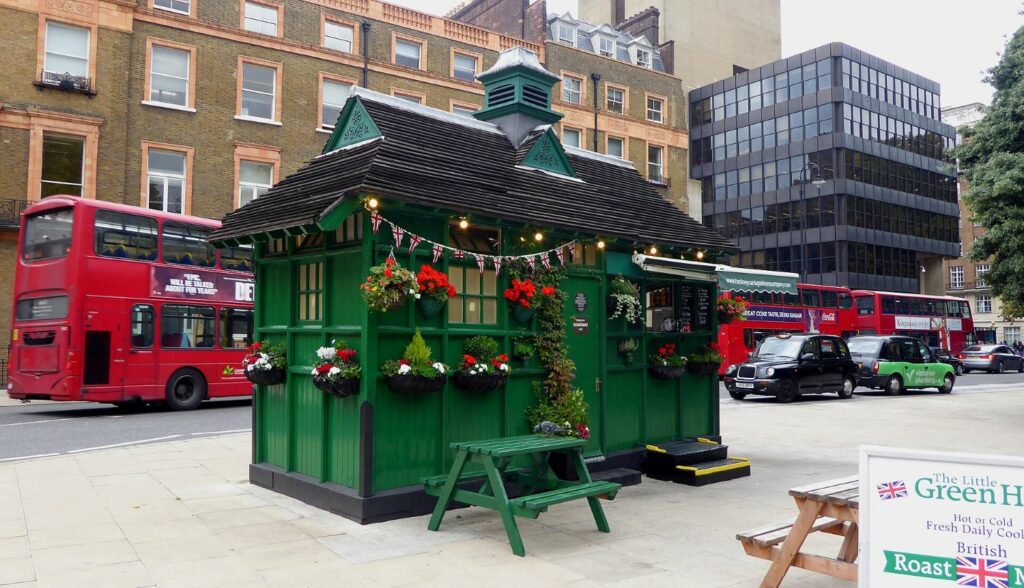
There is a queue at the hatch in Russell Square most mornings. Office workers from the Bloomsbury blocks and tradespeople between jobs stand on the pavement waiting for a bacon roll from a wooden hut about the size of a garden shed, painted a green so particular it has its own Dulux name: Buckingham Paradise 1.
The seats inside belong to cabbies. They always have.
This year the Cabmen’s Shelter Fund turned 150. Of the sixty-one shelters it put up across London between 1875 and the First World War, thirteen still stand, and every one of them is now Grade II listed. On paper that reads like a preservation success story. Mind you, saving a building and saving the reason it was built are separate jobs, and London has only really bothered with the first.
How did London end up with sixty-one green huts?
The founding story has been polished by a century and a half of retelling, so treat it with a pinch of salt. Captain George Armstrong, editor of The Globe, went looking for a cab during a storm one night and couldn’t find one. Every driver on the rank had gone to the pub.
He had a point about the pub.
Victorian law barred a driver from leaving his hansom unattended on a rank. A cabman who wanted a hot meal on a winter shift had two options: go hungry on the box, or pay some loiterer to mind the horse while he ducked into the nearest tavern – and the minder, often enough, helped himself to whatever was in the cab. Armstrong’s solution was to bring the refuge to the rank. The first shelter opened on Acacia Road in St John’s Wood in February 1875, and sixty more followed before 1914.
Why is every shelter the size of a horse and cart?
They stood on the public highway, and the Metropolitan Police would only tolerate a structure there if it took up no more room than a cab and its horse. So the huts are long and narrow, and all of them share the same proportions.
The ornamental version most Londoners picture – pitched roof, decorative panels with the letters CSF worked into the fretwork – was the design of the architect Maximilian Clarke. No alcohol was served. That was rather the point.
Who is still eating inside them?
Fewer cabbies than at any point in the Fund’s history, and the reason has very little to do with timber or paint.
The number of licensed black cabs in London fell by more than 7,000 between 2013 and 2023, leaving roughly 15,100 on the road. Each of those drivers spent three or four years on the Knowledge, memorising the streets within six miles of Charing Cross, for a trade that now competes with anyone holding a smartphone and a private hire licence. When Huck magazine interviewed Jimmy Jenkins, the Fund’s chairman, in October, he described the whole cab trade as “basically on a downward spiral”.
Jenkins doesn’t hide who he blames. He told Huck that David Cameron and George Osborne leant on Boris Johnson, then mayor, to license Uber when it arrived in London. You can argue about the backroom details. The outcome is harder to argue with, and here is where I’ll plant a flag: letting app-based minicabs flood central London on the same terms as drivers who had passed the Knowledge was a bad decision, and the cabmen’s shelters are one of the places you can see the bill arriving.
The pressure doesn’t come from Uber alone. The Elizabeth line now carries people from Paddington to the City in the time it takes a cab to clear Marylebone Road, and Sadiq Khan’s Superloop express buses now ring outer London. Every one of those changes might be sensible transport policy. The huts feel each of them anyway.
Does a shelter still work as a business?
Just about, and only when the person running it works at it. The shelter keepers operate the kitchens as small independent concerns, selling to cabbies inside at a slight discount and to the public through the hatch.
The room itself is tiny. A galley kitchen at one end, a bench along the wall, and barely room to turn round between them. The hatch menu has drifted with the decades – tea and coffee, breakfast baps, and at some huts a spicy wrap that no Victorian cabman would have recognised – but the prices still undercut the chains on the nearest high street by a distance.
A chef at one hut explained to Huck that drivers are loyal if you give them a clean, safe room and decent food cheaply – some of theirs come back two or three times a week. That model depends on volume. A hut serving a dwindling pool of cabbies has to lean harder on passing trade, which is how Russell Square survives: the Bloomsbury lunch crowd props up the counter the drivers used to fill on their own.
Other shelters have no Bloomsbury to lean on. Pont Street in Knightsbridge sits among mansion blocks where few residents are hunting for a breakfast roll. Warwick Avenue in Maida Vale is lovely and quiet, which is precisely the problem.
Is the Cabmen’s Shelter Fund its own worst enemy?
Here is the awkward bit. The charity charged with keeping these huts alive has spent the last few years keeping people away from them.
Jenkins imposes a blanket ban on shelter keepers talking to the press. He told Huck that journalists and film crews used to shoot inside the shelters without permission and the Fund never saw a penny, so he stopped it. After a trustees’ meeting, the magazine was told that no media could use the shelters without a reasonable donation. Several keepers, speaking off the record, said they were nervous of getting into trouble.
He also told the reporter that publicity would bring no new customers, because Americans and Europeans already know the shelters exist.
He is wrong about that. Tourists photograph the huts; very few of them know they can buy a cup of tea through the hatch. Neither do plenty of Londoners, who walk past the shelters on Temple Place and Kensington Park Road every day without a second look. One keeper told Huck, anonymously, that they wanted the huts back on the map, and admitted that as the trade declined the buildings hadn’t always been looked after. Keepers scrub the outsides themselves where they can. London grime wins most weeks.
A trade that is shrinking cannot afford a charity that treats curiosity as a threat.
What does it cost to paint a hut on Kensington Park Road?
£28,000, apparently.
The paint job itself comes to about £6,000. The Kensington Park Road shelter stands in the middle of the road, though, and to reach it the Fund has to suspend the cycle bays and the residents’ parking bays around it, which Jenkins says costs a further £22,000. So a routine lick of Buckingham Paradise green becomes a council-approved small fortune, and the shelter waits.
What does a Grade II listing protect?
The timber, mostly.
Historic England has now listed all thirteen surviving shelters, Pont Street and Chelsea Embankment among the most recent additions in June 2022. Listing means nobody can tear one down or rip out the fretwork without consent. It says nothing about whether a kettle will be boiling inside in ten years, or whether anyone with a green badge will be there to drink the tea.
London already has a cautionary example. The red K6 telephone boxes survived as listed objects long after anyone needed a payphone, and many now serve as coffee kiosks or places to hang a defibrillator. They are pretty. They are also props.
Should the public be let inside?
No – and this is the opinion most likely to annoy people who love the shelters. Opening the seating to everyone would bring in more money, and it would finish the huts off as working cabbies’ rooms within a year. The hatch is the compromise, and it’s a good one. Buy the roll. Leave the bench to the driver who has been circling Victoria since five.
Where can you still find the thirteen?
Mostly in Westminster, with a few strays over the borough borders. Walk from Hanover Square in Mayfair down to Grosvenor Gardens by Victoria station and you’ll pass through the densest cluster. St George’s Square in Pimlico and the Chelsea Embankment shelter cover the river. Thurloe Place sits on the edge of South Kensington’s museum crowds, Kensington Road has its own, and Wellington Place in St John’s Wood keeps an eye on Lord’s.
Embankment Place, by the Tube, is the one most Londoners have walked past without noticing.
Which one looks most like it did in 1900?
Head for Temple Place, at the corner of Surrey Street. That shelter dates from 1900 and has been altered less than most of its siblings, so the proportions and panels are close to how Clarke drew them. Mind you, go early. The hatch shuts when the morning trade dries up, and a hut with its shutters down is just a green box on the Embankment with CSF carved into the wood.
