
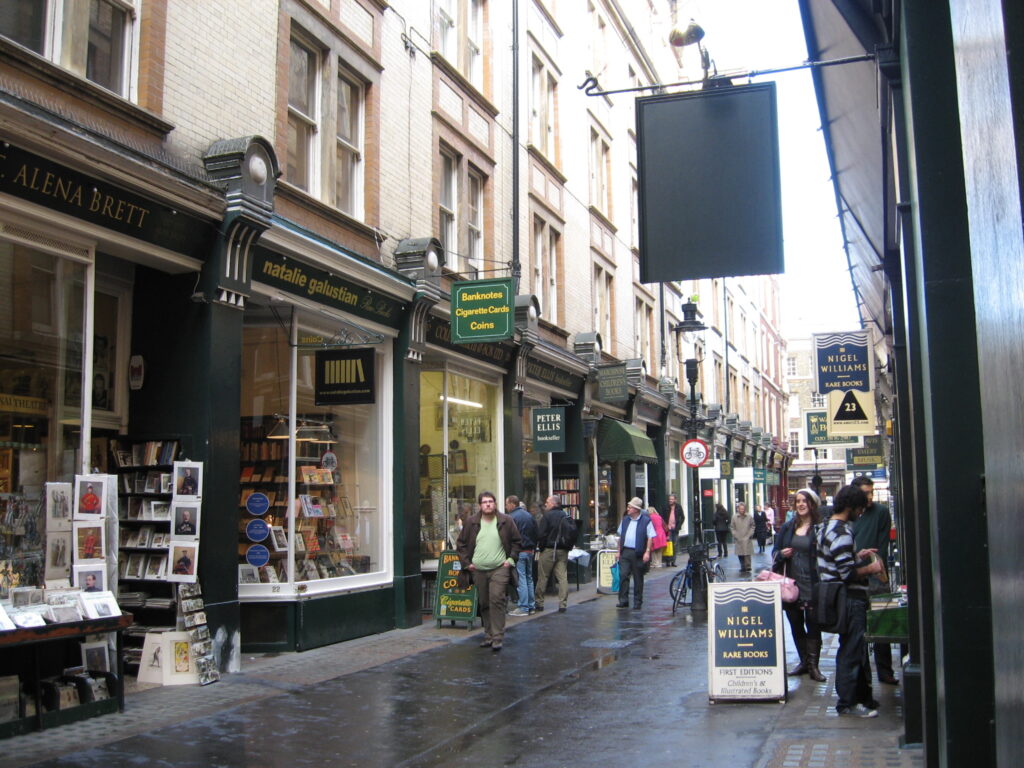
Watkins Books moved into 21 Cecil Court in 1901. This year it has been at the same address for 125 years, selling Jung and tarot decks from the shop where Aleister Crowley and W.B. Yeats once browsed. Fifty yards away, the crowds pour out of Leicester Square station towards the chain restaurants.
That’s the whole mystery of Cecil Court in one short walk.
The alley runs about 300 feet from Charing Cross Road to St Martin’s Lane, on some of the most expensive retail land in the country, and it is still lined with antiquarian booksellers and map dealers. Economics says it should have gone the way of the rest of Charing Cross Road decades ago. It hasn’t, and the reason is almost embarrassingly old-fashioned. The same family has owned it since 1609, and the family has decided it likes books.
What makes Cecil Court so unusual?
Walk in from Leicester Square station and the noise drops away within a few steps. The Victorian shopfronts on both sides match, with painted signwriting and small panes of glass, and behind them sit roughly a dozen specialist dealers. Some sell modern first editions. Others deal in early printing, antique maps, children’s books or esoterica. Goldsboro Books, founded in 1999 by David Headley and Daniel Gedeon, has built a following for signed first editions and has run the Glass Bell Award for fiction since 2017.
The street also carries a claim, repeated in almost every guide, that it inspired Diagon Alley in Harry Potter. Nobody has ever produced much proof. The bookshops don’t seem to mind.
Why do all the shopfronts match?
Because one landlord rebuilt the whole street at once. The Cecil Court you see today dates from 1889 to 1894, when the old Georgian houses were cleared and the lane was straightened and shifted several yards south. One owner built it to one set of proportions, and 130 years later nobody has been allowed to bolt a plastic fascia onto any of it.
How did the Prime Minister’s slum become Booksellers’ Row?
Robert Cecil, first Earl of Salisbury, bought the land in 1609. He was Secretary of State to Elizabeth I and James I, and the family that descends from him still lives at Hatfield House in Hertfordshire. Cranbourn Street and the Salisbury pub on St Martin’s Lane are named after the same family.
For its first two centuries the court was nothing special, and occasionally worse. In 1735 a brandy-shop keeper called Elizabeth Calloway was tried for starting a fire that burnt down several houses in Cecil Court and neighbouring St Martin’s Court. Witnesses said her barrels were empty and her stock over-insured. The jury acquitted her anyway.
The street’s history, compiled by the dealers Bryars & Bryars for the Cecil Court website, is full of details like that, and the best of them involves a barber. Between April and August 1764, an eight-year-old Wolfgang Amadeus Mozart lodged with his family above John Couzin’s shop, paying twelve shillings a week for three cramped rooms. Tickets for his London concerts were sold from the premises. After careful map work, the history places Couzin’s shop on the site of today’s number 9, its old threshold now under the open pavement.
By the 1880s the buildings were falling apart, and the landlord happened to be the Conservative Prime Minister, the third Marquess of Salisbury. The Liberal press had a field day. In October 1888, when a roof in the court gave way, The Star gleefully reported the collapse of the Prime Minister’s slum property a stone’s throw from Parliament. The embarrassment worked. The realignment agreement was signed in May 1889, and the new buildings went up by 1894.
The first tenants were film companies, including Cecil Hepworth, who released an early film of Alice in Wonderland from number 17 in 1903. The street became Flicker Alley. The booksellers arrived at the same time. Watkins came in 1901, and in 1904 William and Gilbert Foyle opened their first West End shop at number 16, at a rent of £60 a year. According to the cartoonist David Low, the brothers sometimes had to borrow from John Watkins to pay their staff. By 1906 they had moved to Charing Cross Road, and the rest is Foyles.
Did Mozart really write his first symphony here?
Possibly. The late Mozart scholar Stanley Sadie argued that the timing only works for Cecil Court. The plaque, however, is in Ebury Street in Belgravia.
Why do Londoners keep coming back?
Partly for the finds, obviously. Mostly for the pace.
Cecil Court is one of the few streets in the West End where nobody minds if you stand still. A young Arthur Ransome spent his lunch hours browsing here around 1901, and the habit has survived him by more than a century. The dealers mostly sit reading at the back and let you get on with it. There are limits, mind you. One of the street’s historic photographs shows a sign in a 1950s bookshop office: “Do not mistake courtesy on my part as an invitation to stay all day.”
In 1983 the court was the set for the Yellow Pages advert in which the elderly J.R. Hartley goes from shop to shop looking for his own book, Fly Fishing. It became so popular that the book was eventually written. Every bookseller on the street has presumably met a real J.R. Hartley since.
Do the photographers buy anything?
Some do. Plenty of visitors now arrive with a phone held out in front of them, take their picture outside the painted windows and leave. I’d rather have them than an empty alley. A tourist who comes for Diagon Alley and walks out of Watkins with a secondhand paperback is still a customer.
What is squeezing a street with a friendly landlord?
Almost everything the landlord can’t control.
The warning is fifty yards away. Charing Cross Road was once London’s great bookselling street, and rising rents have pushed out many of its small independents. Foyles left its old building at 119 in 2014 for a new flagship further up the road, and the second-hand stretch has shrunk to a handful of survivors, Any Amount of Books and Henry Pordes among them.
Then there’s the internet, which has turned the rare book trade into a global market where a first edition in Cecil Court competes with the same edition listed in Ohio. Plenty of dealers now do much of their selling online, and the shop becomes as much a shop window as a till.
And this spring there was the taxman. On 31 March, the 40% business rates relief for shops, pubs and restaurants ended, replaced by lower multipliers for retail, hospitality and leisure properties. For small shops in the West End, where rateable values are high, the relief was worth real money.
Can a landlord protect a shop from the taxman?
No. A landlord sets the rent. It has no say over business rates, which are calculated by the Valuation Office Agency and paid by the tenant. A kind estate can keep a shop’s biggest cost low and still watch it struggle with the second biggest.
What does the Cecil estate actually do for the bookshops?
It holds its nerve.
The details of the estate’s lettings aren’t public, and the reporting on them is thinner than the legend suggests. A 2009 piece on Londonist described Lord Salisbury as a sympathetic landlord, taking care to add that he was no “wealthy benefactor”, but keen to keep Cecil Court as the specialist book street it had been for a century. A 2022 report by WhoWhatWhy went further, stating that rents on the court are kept below market rates and that the shops are reserved for antiques and book dealers. The Cecil Court traders describe their businesses as independent and largely owner-run, and the mix on the street bears that out.
The mechanism is simple enough. An estate that has held land for four centuries doesn’t need to sell it or answer to shareholders every quarter. It can choose a tenant who will stay thirty years over one who will pay more for five. It can refuse the vape shop. On a street of Cecil Court’s size, the difference between market rent and a bookseller’s rent is a rounding error in a landed family’s
